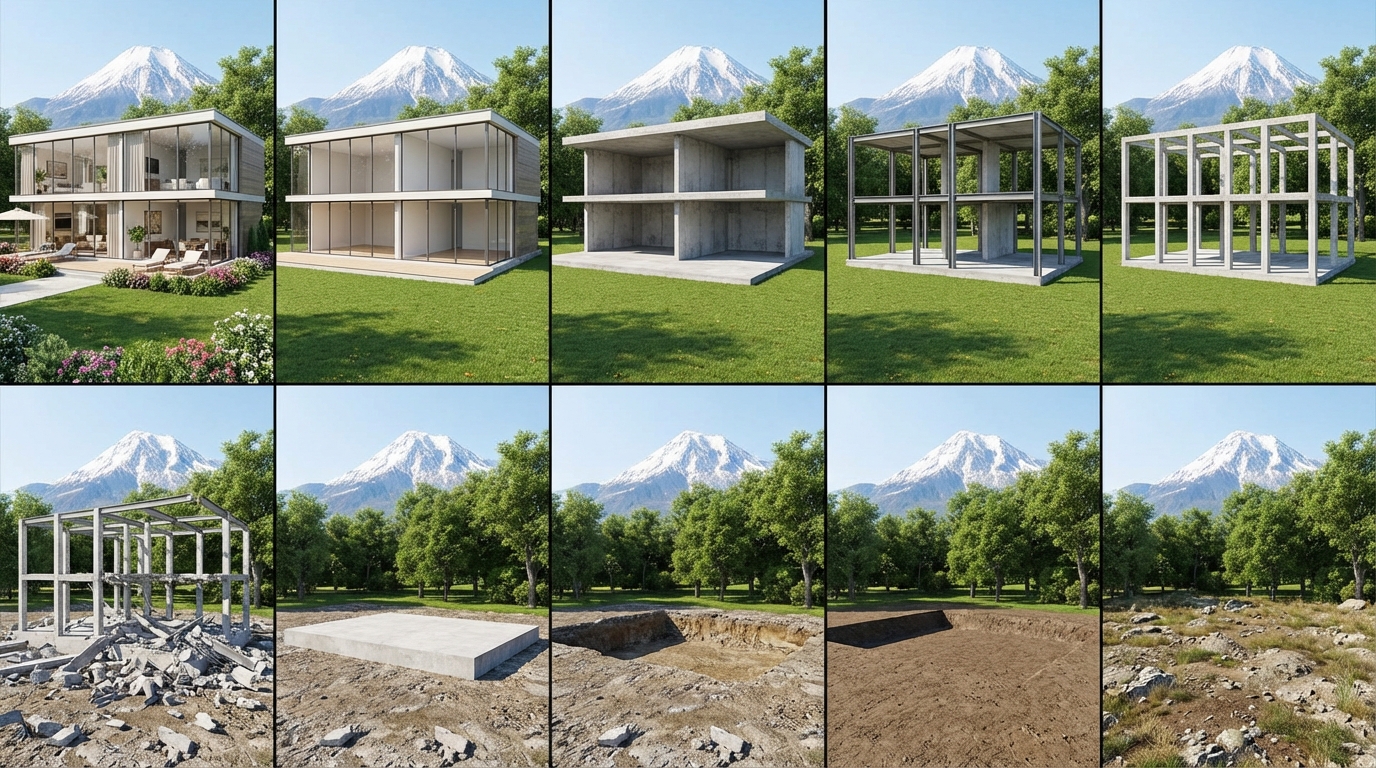
Ein 5x2-Storyboard zeigt den rückwärts gedachten Rückbau einer modernen Villa in zehn Bildern, von vollständig möbliert bis zu naturbelassenem, unordentlichem Gelände. Jedes vertikale Bild im Seitenverhältnis 9:16 nutzt dieselbe Kamera, Perspektive, Tiefenschärfe und helles natürliches Tageslicht; das gesamte Raster hat 45:32. Die Sequenz folgt strikt dem Subtraktionsprinzip: Bis Bild neun werden nur vorhandene Elemente entfernt, im letzten Bild wird nur der Boden in einen ungezähmten Naturzustand zurückgeführt.
Diese Uebersetzung dient nur dem Verstaendnis. Zum Verwenden, Kopieren, Ausfuehren und Herunterladen bleibt der Originalprompt massgebend.
Erstelle als architektonische Visualisierung ein Storyboard mit zehn Einzelbildern in einem 5x2-Raster, angeordnet in zwei Reihen mit je fünf Spalten. Jedes Einzelbild hat ein vertikales Seitenverhältnis von 9:16, das gesamte Storyboard hat 45:32. Kamera, Blickwinkel, Komposition, Tiefenschärfe und helles natürliches Tageslicht bleiben in allen Bildern identisch, und es darf kein Text im Bild erscheinen. Die Szene zeigt den Rückbau einer modernen Villa nach einem strengen Subtraktionsprinzip: In den Bildern eins bis neun dürfen nur Elemente entfernt werden, die im vorherigen Bild bereits vorhanden waren; es werden keine neuen Objekte hinzugefügt. Bild eins zeigt die komplette Villa mit Möbeln, Vorhängen, Topfpflanzen, Teppichen, Kunstwerken, Aussenliegen, Sonnenschirm, gepflegtem Rasen, Blumenbeeten, Glasfassade und fertiger Aussenhülle. Bild zwei entfernt alle weichen Einrichtungs- und Dekorelemente, während fertige Böden, Wände und Decken bleiben. Bild drei entfernt Innenausbauten wie Beläge, Putz, Deckenplatten und Leuchten, sodass Rohbeton und rohe Wanduntergründe sichtbar werden. Bild vier entfernt die gesamte Glashülle, Fenster- und Türrahmen, Fassadenbekleidung und Dämmung. Bild fünf entfernt nicht tragende Wände und Brüstungen, sodass nur das primäre Tragwerk aus Betonstützen, Stahlträgern und Deckenplatten bleibt. Bild sechs zeigt den Einsturz des Tragwerks zu Schutt mit Betonbrocken, verbogener Bewehrung und gebrochenem Stahl. Bild sieben entfernt allen Schutt und legt das saubere rechteckige Fundament frei. Bild acht entfernt das Betonfundament vollständig und hinterlässt eine ausgehobene Grube mit verdichtetem Boden oder Fels am Grund. Bild neun entfernt künstliche Landschaftselemente wie Terrassenbelag, Betonauffahrt, gepflegten Rasen und kultivierten Boden; die Grube ist wieder auf ursprüngliches Niveau verfüllt. Bild zehn stellt den Boden als natürlichen, unordentlichen Zustand wieder her, mit unebenem Gelände, freiliegenden Steinen, Erdflächen und verstreutem trockenem Unkraut. Der schneebedeckte Berg und die jahrhundertealten grünen Bäume bleiben in allen Bildern unverändert in Position, Grösse, Form und Laubfarbe.
Act as an architectural visualization expert specialized in building design and home renovation. Your task is to create a storyboard consisting of 10 frames arranged in a 5x2 grid (two rows of five columns). Each frame should have a 9:16 aspect ratio in a vertical format. Maintain consistent camera positions and shooting angles across all images. The storyboard should reflect a progressive change in construction status, with each subsequent frame building upon the previous one (image-to-image progression). Ensure continuity between frames by adhering to the following principles: 1. **Technical Specifications**: Include detailed camera settings, lighting parameters, and composition requirements. 2. **Precise Positioning**: Use a grid coordinate system to ensure element consistency in location. 3. **Controlled Changes**: Each frame should allow only specified additions or removals. 4. **Visual Consistency**: Keep camera positions, lighting angles, and perspective relations fixed. 5. **Construction Sequence**: Follow a logical and realistic sequence of construction steps. 6. **Removal Constraints**: Only remove debris and dilapidated items. 7. **Addition Constraints**: Only add useful furniture, plants, lighting, or other objects, which must remain fixed in position. Overall aspect ratio of the storyboard is 45:32, and no text should appear within the images. **Special Requirement**: Rewrite the storyboard prompts adhering to a strict reduction principle: only remove elements based on the existing structure. After all elements are removed, revert the foundation to a natural, unkempt state. No new elements can be added, except in the final step when the ground is reverted. **Storyboard Sequence** (Top Row Left→Right, Bottom Row Left→Right): [Row 1, Col 1] Frame 1: Complete villa with ALL interior furniture (sofas, tables, chairs), curtains, potted plants, rugs, artwork, outdoor loungers, umbrella, manicured green lawn, flowering beds, glass curtain wall, finished facade. Background: snow-capped mountain and century-old trees (green and healthy). [Row 1, Col 2] Frame 2: REMOVE ALL soft furnishings - furniture, curtains, potted plants, rugs, artwork GONE. Rooms are empty but floors/walls/ceilings remain finished. Terrace is bare stone, flower beds are empty soil patches. Mountain and trees unchanged. [Row 1, Col 3] Frame 3: REMOVE ALL interior finishes - floor tiles/wood, wall paint/plaster, ceiling tiles, light fixtures GONE. Raw concrete floors and rough wall substrates visible. Open concrete soffits overhead. Mountain and trees unchanged. [Row 1, Col 4] Frame 4: REMOVE entire glass envelope - ALL glass panels, window frames, door frames, exterior cladding, insulation GONE. Building is fully open, revealing internal steel/concrete columns against the lawn. Mountain and trees unchanged. [Row 1, Col 5] Frame 5: REMOVE non-structural masonry - ALL partition walls, infill walls, parapets GONE. ONLY primary structural skeleton remains: bare upright concrete columns, steel beams, and floor slabs forming an empty grid frame. Mountain and trees unchanged. [Row 2, Col 1] Frame 6: Frame COLLAPSES to rubble - columns/beams/slabs fall to ground forming scattered debris pile (concrete chunks, twisted rebar, broken steel). Concrete foundation partially visible through debris. Upright framework GONE. Mountain and trees unchanged. [Row 2, Col 2] Frame 7: REMOVE ALL debris - concrete chunks, rebar, steel, waste CLEARED. Lawn debris-free. Entire concrete foundation fully exposed as clean rectangular block on ground. Mountain and trees unchanged. [Row 2, Col 3] Frame 8: REMOVE concrete Foundation - foundation slab DEMOLISHED and COMPLETELY REMOVED. Empty excavated pit remains with compacted soil/bedrock at bottom. No concrete remains. Mountain and trees unchanged. [Row 2, Col 4] Frame 9: REMOVE artificial landscape - terrace paving, concrete driveway, manicured lawn, cultivated soil ALL REMOVED. Pit filled back to original grade. Site becomes flat field of natural uncultivated soil and earth. Mountain and trees unchanged. [Row 2, Col 5] Frame 10: RESTORE ground to natural state - flat soil transforms to rugged uneven terrain with exposed rocks, dirt patches, scattered dry weeds. Ground appears untamed and messy. Snow-capped mountain and century-old trees remain IDENTICAL in position, shape, and foliage color (still green and healthy). Bright natural daylight persists throughout. **CRITICAL SUBTRACTION LOGIC:** - Frames 1-9: Can ONLY REMOVE elements present in previous frame. NO additions allowed. - Frame 10: RESTORE ground from artificial to natural state only. **Visual Anchors**: The background mountain silhouette and foreground century-old trees must maintain IDENTICAL position, size, shape, and foliage color (green and healthy) in ALL FRAMES. These serve as reference points for visual continuity. **Lighting Consistency**: All frames must use bright, natural daylight. No dark, gloomy, or stormy lighting, especially in final frame. **Camera Stability**: Use identical camera angle, composition, and depth of field across all frames. Viewing perspective must be locked.